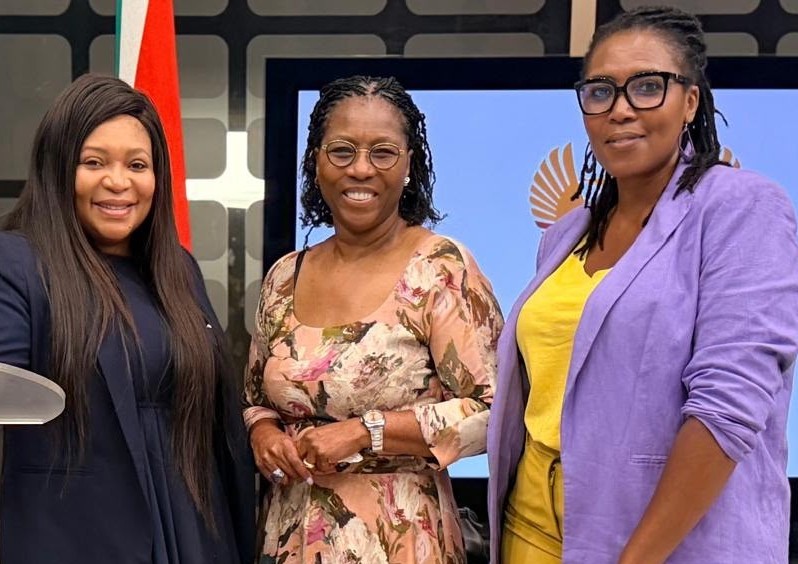
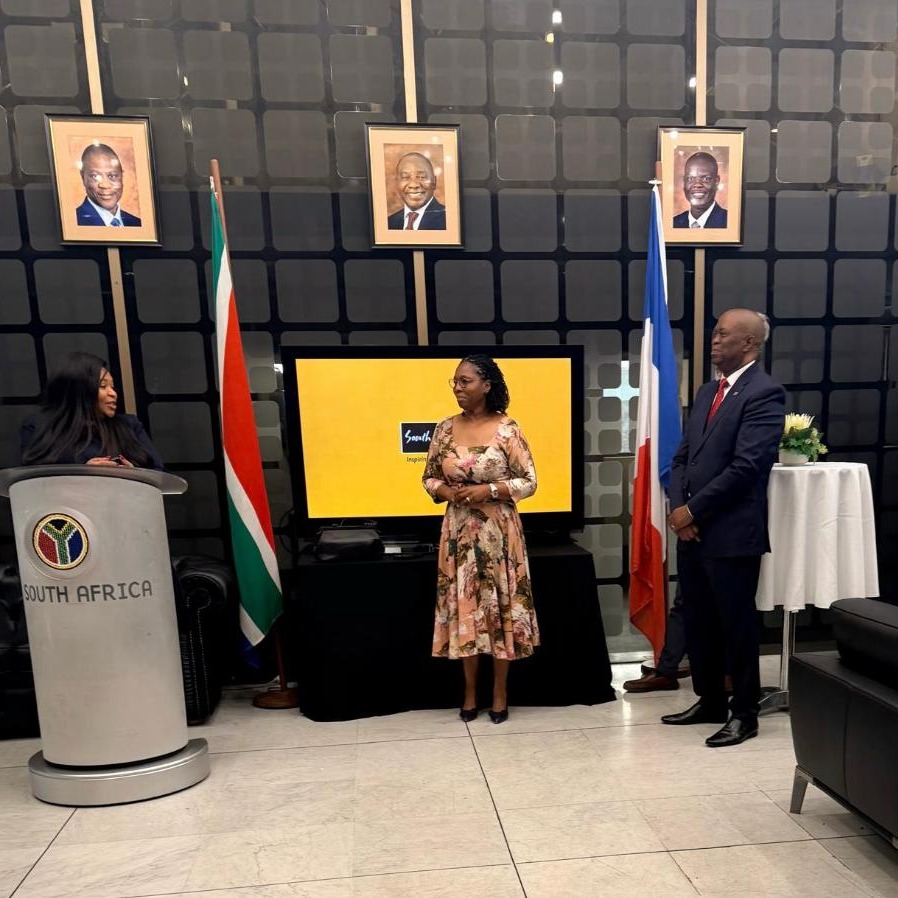
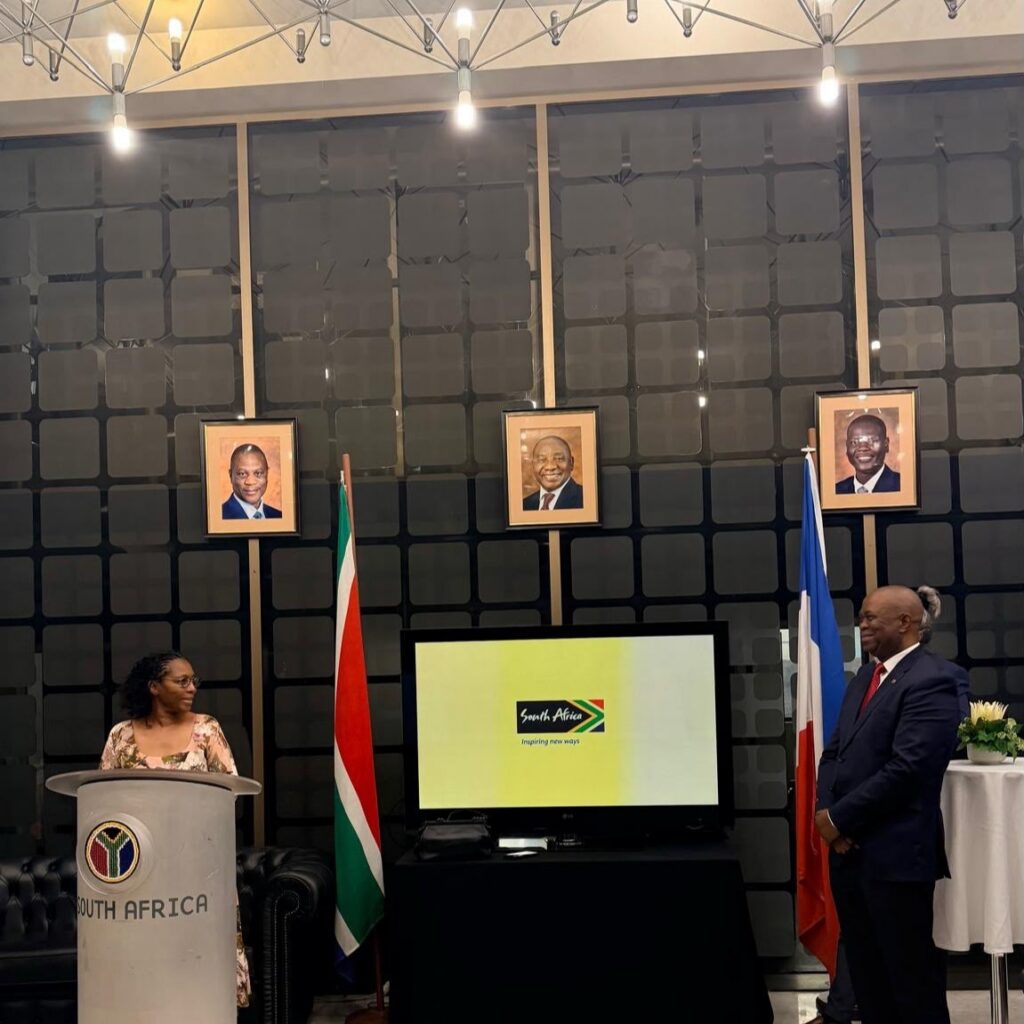
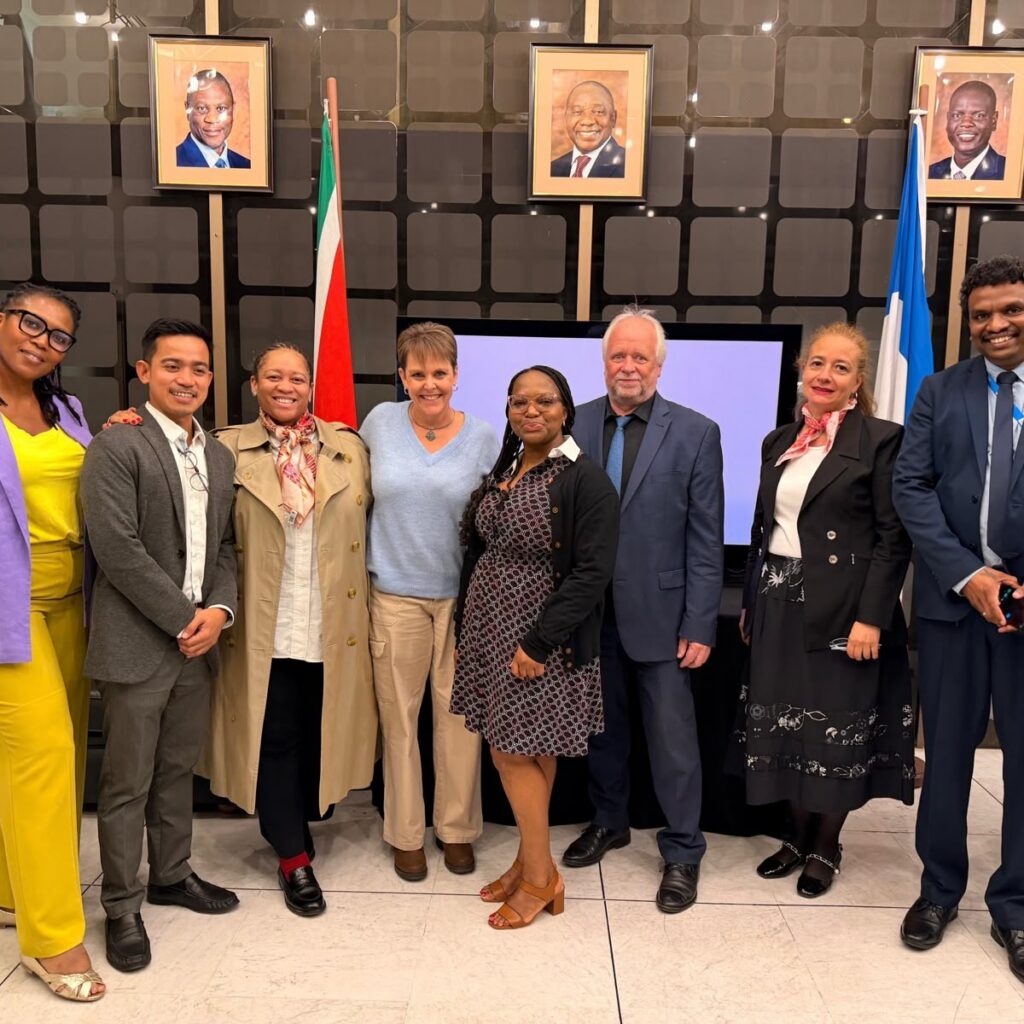
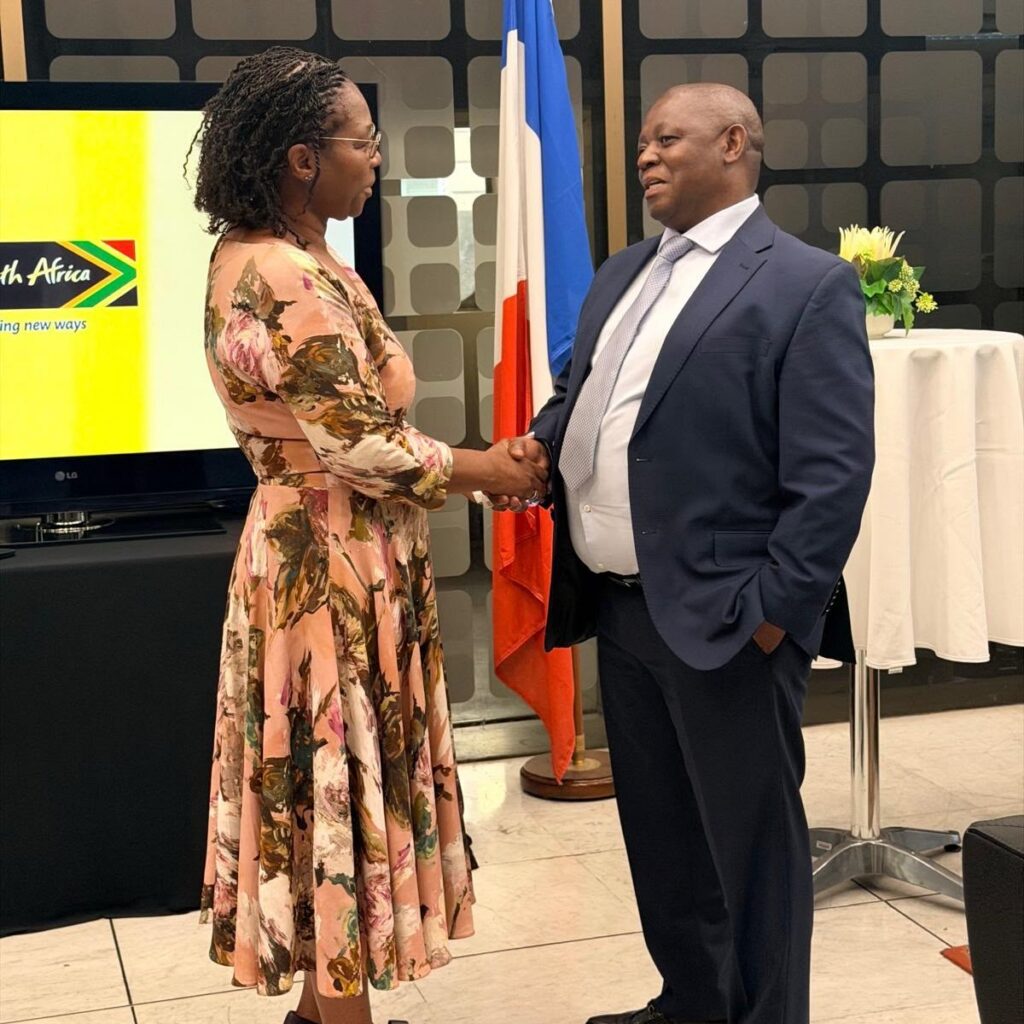
Newly appointed South African Ambassador Extraordinary and Plenipotentiary to the French Republic, H.E. Ayanda Dlodlo, has officially begun her tour of duty in France, receiving a warm welcome from staff at the South African Embassy in Paris.
The arrival marks the beginning of a new chapter in the career of a public servant who has held senior positions across South Africa’s government, public administration and international institutions.
Ambassador Dlodlo’s appointment comes at a significant time in South Africa–France relations, with the two countries maintaining cooperation across political, economic, investment, energy, science and technology, defence, health, education, culture and multilateral affairs.
Ayanda Dlodlo: A career spanning government and international institutions
Ambassador Dlodlo brings extensive public-sector and international experience to her new diplomatic assignment.
According to the South African Government’s official profile, she holds a Master of Business Administration (MBA), alongside postgraduate qualifications in management development, business management and executive development. Her professional career has included senior positions in both the public and private sectors, including experience with Telkom, Spoornet, Sanlam and the Gauteng Department of Community Safety. She also served as Deputy Head of the Directorate of Special Operations, commonly known as the Scorpions.
Her professional background therefore extends beyond politics and government, encompassing business, transport, telecommunications, public administration and law-enforcement structures.
From Parliament to Cabinet
Dlodlo entered the National Assembly in 2009 and subsequently served as Parliamentary Counsellor to the President between 2009 and 2010 before becoming Deputy Minister of Public Service and Administration. She held the deputy ministerial position from 2010 until March 2017.
Her subsequent Cabinet career saw her serving in several portfolios.
In 2017, she was appointed Minister of Communications, before later becoming Minister of Home Affairs. In 2018, she was appointed Minister of Public Service and Administration. Following the formation of the sixth administration in 2019, she served as Minister of State Security, before returning to the Public Service and Administration portfolio in 2021.
This experience gave Dlodlo exposure to several areas of government, including public administration, communications, home affairs and national security.
Experience in global governance
Dlodlo’s career has also included a substantial international and multilateral dimension.
She served as South Africa’s Special Envoy to the Open Government Partnership (OGP) from 2011 to 2019. The OGP is a multilateral initiative focused on areas including transparency, accountability, citizen participation and open government.
During her tenure, South Africa played an active role in the partnership, including serving as Lead Chair of the OGP Steering Committee. In 2016, Dlodlo, then Deputy Minister of Public Service and Administration, hosted an OGP leadership retreat in Johannesburg involving government and civil society representatives from several countries, including France.
The Open Government Partnership has therefore been one of the areas in which Dlodlo gained direct experience engaging with international counterparts and multilateral institutions.
The French Institute of South Africa also recently identified her previous experience as South Africa’s OGP Special Envoy and highlighted her participation in discussions on open government, transparency, citizen participation and digital governance.
From South African Cabinet to the World Bank
After leaving the South African Cabinet and Parliament in 2022, Dlodlo moved into another international role.
She joined the World Bank Group, initially serving as Alternate Executive Director from April 2022 before becoming Executive Director for the constituency representing Angola, Nigeria and South Africa in November 2022.
In that role, she represented the interests of the three countries on the World Bank Group’s Board and participated in discussions concerning development financing, economic development and international cooperation.
The World Bank’s own records identify Dlodlo as its Executive Director representing Angola, Nigeria and South Africa.
Her World Bank experience adds another dimension to her new diplomatic role, particularly given the growing importance of economic diplomacy, investment, development finance and international economic partnerships.
A new diplomatic assignment in Paris
Dlodlo has now moved from representing South African interests within a major multilateral financial institution to representing South Africa directly as its ambassador in France.
Her appointment was announced in 2026, with President Cyril Ramaphosa appointing her to succeed the late Ambassador Nathi Mthethwa.
As Ambassador Extraordinary and Plenipotentiary, Dlodlo will head South Africa’s diplomatic mission in Paris and engage with the French Government and other stakeholders on behalf of South Africa.
Her responsibilities will encompass political and diplomatic engagement, economic and commercial relations, investment promotion, consular matters and broader cooperation between South African and French institutions.
South Africa and France: A Strategic Partnership
Ambassador Dlodlo takes up her assignment against the backdrop of an established relationship between South Africa and France.
Formal diplomatic relations between the two countries were normalised following South Africa’s first democratic elections in 1994. The relationship subsequently developed through a series of high-level visits, including former President Nelson Mandela’s State Visit to France in July 1996 and French President Jacques Chirac’s visit to South Africa in June 1998.
The relationship has continued to develop through regular political engagement.
South Africa and France established a Forum for Political Dialogue (FPD) in 1997, providing a structured mechanism for discussions between the two countries. The relationship also includes cooperation at regional and multilateral levels.
Presidential engagement
High-level engagement has continued in recent years.
President Cyril Ramaphosa undertook an official visit to France in May 2021, while French President Emmanuel Macron undertook a State Visit to South Africa from 28–29 May 2021. The discussions covered bilateral and multilateral issues, including the international response to the COVID-19 pandemic.
More recently, the South African Presidency announced another official visit by President Ramaphosa to France in July 2026, including discussions with President Macron and engagements with French business leaders.
The Presidency described South Africa–France relations as comprehensive and productive, covering cooperation in areas including energy, science and technology, defence, trade and investment, arts and culture, tourism, higher education and training, and health.
Trade and investment
Economic relations form an important component of the bilateral partnership.
South Africa’s Department of International Relations and Cooperation identifies France as an important trade and investment partner. Its bilateral relations profile records bilateral trade of approximately R40.5 billion in 2021, while French foreign investment in South Africa stood at approximately R89 billion at the end of that year. French companies have invested across sectors including financial services, renewable energy, rail, chemicals, oil and gas.
France’s Ministry for Europe and Foreign Affairs similarly reports significant French corporate activity in South Africa, noting that hundreds of French companies operate in the country and employ tens of thousands of people.
This economic dimension is particularly relevant to South Africa’s efforts to expand trade, investment, industrial cooperation and market opportunities.
Energy, science, health and innovation
The bilateral relationship extends well beyond traditional diplomacy.
Energy cooperation has become an important area, particularly in the context of South Africa’s transition towards a lower-carbon economy. France and South Africa also cooperate in science and technology, healthcare, education and skills development.
In healthcare, France highlights cooperation involving a vaccine production hub in Cape Town designed to support vaccine manufacturing in Africa and facilitate technology transfer, including in the field of mRNA technology.
Cultural cooperation is also supported through institutions such as the French Institute of South Africa (IFAS) and the Alliance Française network in South Africa.
A relationship with a strong multilateral dimension
South Africa and France also engage on international issues through multilateral institutions.
The two countries cooperate on issues including climate change, environmental matters, international peace and security and global governance. The French Government notes that France has an interest in South African perspectives on international and regional peace and security.
This provides an additional dimension to the work of the South African Embassy in Paris, which is responsible not only for bilateral relations with France but also for representing South African interests within a major European diplomatic and multilateral environment.